


BIM for FM: Simplifying Building Maintenance Operations
Understanding BIM’s Role in Facilities Management
What is BIM FM and why it matters
BIM FM refers to the application of Building Information Modeling in facilities management, where data-rich digital models are used to operate and maintain buildings more efficiently. Rather than starting from scratch post-construction, facilities managers inherit a complete digital record of the building, including systems, components, and spaces. This model enables real-time decision-making based on accurate and structured building data. The goal is simple: to make maintenance predictable, documentation accessible, and interventions less reactive.
In conventional settings, maintenance relies on outdated as-built drawings or fragmented information. BIM FM replaces this with a digital model that offers a single source of truth. From HVAC systems to fire safety assets, every element is tagged and connected to its operational history. This approach helps teams identify problems quickly and allocate resources more effectively. It also supports long-term planning by offering visibility into lifecycle costs, performance benchmarks, and future refurbishment needs.
The link between design intent and operational efficiency
Facilities management often suffers when operational teams are excluded from the design and construction phases. Without insight into what was installed or how systems interconnect, maintenance staff are left to interpret incomplete records. BIM creates continuity by embedding facilities data into the design process. This ensures that when the building is handed over, every asset is accounted for, and its role in the overall system is clearly understood.
Operational efficiency improves when teams can access detailed information about equipment location, manufacturer data, and service history without leaving their workstation. By aligning the model’s structure with FM workflows from the beginning, project teams can deliver outcomes that serve long after the ribbon-cutting. That connection between initial design intent and eventual performance is what allows BIM FM to deliver long-term value.
Common challenges in traditional building maintenance workflows
Traditional building maintenance often relies on manual systems, paper-based records, and reactive problem-solving. Critical data is scattered across spreadsheets, filing cabinets, or siloed software platforms. When something breaks, locating the relevant plans or specifications can delay response times, raise costs, and frustrate occupants. This lack of accessibility slows even basic tasks like locating shut-off valves or identifying serviceable components.
Another issue is knowledge loss over time. As team members retire or move on, undocumented practices disappear with them. BIM FM helps preserve that knowledge in a structured format, where procedures, warranties, and maintenance logs are accessible to everyone. It provides a system that retains institutional memory and improves operational consistency, no matter who is on the team.
From Construction to Operations: A Digital Continuum
The lifecycle approach to data management
Effective facilities management begins long before the first maintenance call. By using BIM throughout the project lifecycle, from early design to operations, teams can maintain consistent data quality. The model becomes a dynamic record, updated at each project milestone, capturing decisions and specifications that would otherwise be lost during handover. This continuity reduces gaps in information, creating a smoother transition from construction to occupancy.
During the operational phase, access to verified building data supports daily tasks and strategic planning. Maintenance teams can review service schedules, track warranties, and plan upgrades with confidence that the data reflects real conditions. A lifecycle approach also encourages better documentation practices, ensuring that every change, repair, or inspection is recorded within the model for future reference.
How handover packages influence long-term operations
Handover is a critical phase where operational teams inherit not just a physical building, but also the digital information needed to maintain it. In many projects, this information is inconsistent, unstructured, or incomplete. A well-prepared BIM handover package addresses these issues by delivering an organised, accessible model that includes asset data, commissioning records, and maintenance requirements aligned with FM needs.
A detailed handover enables facilities teams to hit the ground running. They can immediately start scheduling maintenance, allocating resources, and responding to service requests using reliable model data. With BIM FM, the transition is no longer a scramble for documents — it’s a controlled, informed process that saves time and improves building performance from day one.
Aligning construction models with FM needs
Many construction models are built with coordination or visualisation in mind, not operations. For BIM FM to succeed, models must be developed with future maintenance in view. This means ensuring that asset data is structured correctly, naming conventions are consistent, and key elements are tagged for integration with FM software systems. Early coordination between project and facilities teams is crucial to achieving this alignment.
The goal isn’t to include every component, but to focus on what matters most in day-to-day operations. Mechanical systems, access panels, and life safety equipment, for example, should be detailed enough for efficient maintenance and troubleshooting. By prioritising operational value during construction, teams can avoid rework later and deliver a model that continues to serve long after project completion.
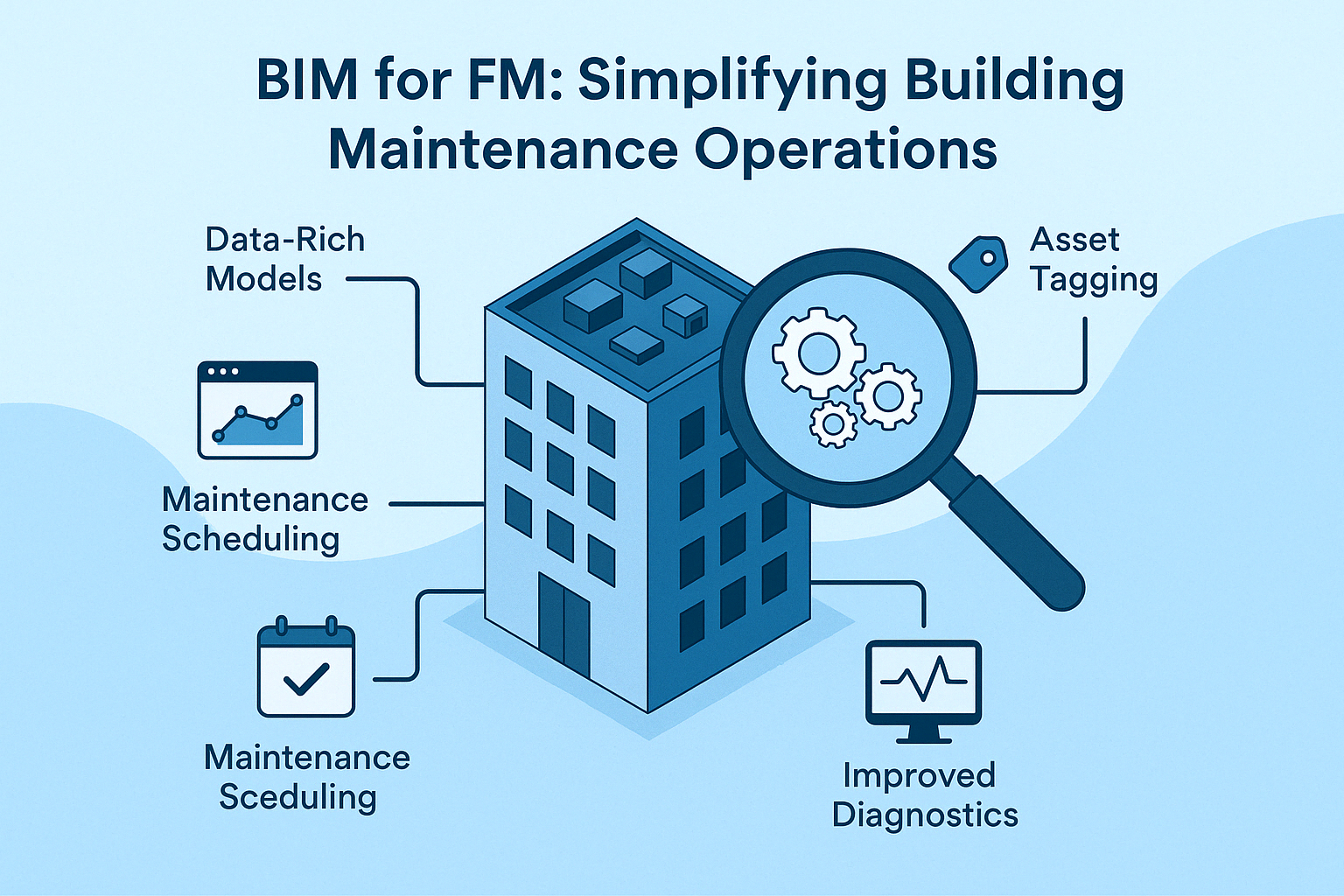
Key Features of BIM for FM Applications
Asset tagging and spatial coordination
Accurate asset tagging is fundamental to any successful BIM FM strategy. Each component, whether it’s a fan coil unit or a lighting fixture, is assigned a unique identifier and linked to relevant metadata — manufacturer details, serial numbers, warranty periods, and scheduled maintenance tasks. These tags allow facilities teams to filter, search, and interact with specific assets in a meaningful way.
Spatial coordination adds another layer of value. With a properly structured BIM model, users can visualise the precise location of each asset within its environment. This helps teams prepare for maintenance activities before even entering the space, reducing disruptions and improving safety. The visual layout can also assist in emergency planning, ensuring first responders and operations staff can locate and isolate systems quickly.
Maintenance scheduling with model-based triggers
BIM FM models can be connected to maintenance schedules, allowing tasks to be driven by usage data, manufacturer recommendations, or time-based triggers embedded in the model. For example, a pump that requires inspection every 3,000 hours can automatically generate a service alert based on operating data, if connected to a Building Management System (BMS). This kind of proactive maintenance reduces the risk of failure and avoids costly downtime.
Even without real-time sensors, model-based scheduling ensures regular tasks are never overlooked. The BIM environment becomes a dashboard, highlighting what needs attention and when. Facilities teams can plan resources more efficiently and document compliance with safety and regulatory standards — all without chasing paper logs or fragmented records.
Integration with Computerised Maintenance Management Systems (CMMS)
The real power of BIM FM emerges when it integrates with existing FM tools like a Computerised Maintenance Management System. CMMS platforms handle service requests, asset tracking, inventory management, and work orders. When these systems are linked to a BIM model, users can click on an asset and pull up its entire service history, warranty information, or even log a ticket directly through the interface.
This integration closes the loop between digital representation and physical action. Staff are no longer switching between software platforms or digging through spreadsheets. Everything they need — spatial data, asset information, maintenance logs — is accessible from a single interface. It creates a more seamless, efficient process that improves response times, accountability, and building performance.
Benefits of BIM FM in Day-to-Day Maintenance
Faster access to building data
Time is often lost tracking down critical information during a maintenance call. Whether it’s a wiring diagram, warranty certificate, or equipment location, delays can add up — especially in large or complex facilities. BIM FM solves this by providing a digital model where everything is stored in one place. With just a few clicks, teams can locate an asset, pull up documentation, and understand its operational context.
This level of accessibility reduces frustration and improves productivity. Instead of relying on outdated floor plans or combing through filing cabinets, maintenance personnel have on-demand access to accurate, up-to-date building information. The result is faster response times and less guesswork, helping staff resolve issues quickly and get systems back online.
Improved service response and diagnostics
When technicians arrive on site with full access to a BIM model, diagnostics become much more precise. They can isolate the faulty component, check installation details, and even simulate surrounding conditions within the digital environment. This cuts down on misdiagnoses, repeat visits, and unnecessary interventions.
BIM FM also supports preventative strategies by helping teams identify potential issues before they escalate. For instance, a technician may notice patterns in service calls tied to a particular asset type or location. With model-based tracking, those patterns are easier to spot and address. This foresight improves operational resilience and reduces unplanned disruptions.
Reducing downtime and extending asset life
Every moment of equipment downtime has a cost, whether it's lost productivity, occupant discomfort, or energy inefficiency. By linking maintenance schedules, service records, and component data, BIM FM helps teams keep assets in optimal condition. Early warnings can prompt repairs before systems fail, and maintenance plans can be fine-tuned based on actual performance data.
This not only reduces downtime but also extends the life of expensive systems. HVAC units, chillers, and electrical panels perform better and last longer when maintained according to their specific needs. With BIM FM in place, facilities managers can track performance trends, plan replacements strategically, and avoid the chaos of emergency fixes.

Collaboration Between Design Teams and Facilities Managers
The importance of early FM involvement
Too often, facilities teams are introduced late in the project lifecycle, once major design and construction decisions have already been finalised. This disconnect can lead to operational inefficiencies, as systems may not be designed with long-term maintenance in mind. When facilities managers are involved from the start, their operational knowledge helps shape smarter decisions — from asset placement to access requirements.
Early collaboration ensures that maintenance strategies are integrated into the design, rather than being retrofitted after occupancy. This reduces long-term costs and improves overall building usability. It also enables facilities staff to become familiar with the digital model early on, building confidence in its accuracy and relevance for day-to-day operations.
Communicating operational needs through BIM
BIM provides a shared platform where project stakeholders can visualise and test ideas collaboratively. Facilities managers can review models during design development, flag concerns about accessibility or servicing zones, and ensure key systems are located logically. This early engagement helps avoid issues that might otherwise go unnoticed until they become costly to resolve.
Using BIM for this kind of communication creates alignment between what is built and what is needed. Design teams gain insight into how systems will be used and maintained, while FM teams have a chance to influence model structure and data fields in ways that support their workflows. This mutual understanding is essential for delivering buildings that are not just functional, but also easy to maintain.
Enhancing long-term value with BIM Architectural Services
High-quality BIM Architectural Services play a critical role in ensuring the handover model delivers lasting operational value. By embedding accurate asset data, defining clear naming conventions, and aligning model organisation with FM software requirements, architectural teams lay the groundwork for long-term efficiency. Their work directly impacts how easily a building can be managed once construction is complete.
When architects and modellers take operational needs seriously, they produce models that do more than meet visual or spatial requirements. They create a reliable source of operational intelligence. This collaboration helps unlock the full potential of BIM FM, giving facilities teams a model that reflects reality and supports effective decision-making for years to come.
Real-World Application: BIM FM in Action
Case example of data-rich models improving operations
A commercial office tower in San Francisco recently implemented BIM FM as part of its post-construction transition. The model handed over included detailed asset information, linked documentation, and consistent spatial coordination. Facilities managers used the model to create a live maintenance dashboard that fed directly into their CMMS. As a result, response times improved by over 30%, and preventative maintenance tasks were executed with greater accuracy.
Service teams could locate shut-off valves, electrical panels, and HVAC units within minutes, thanks to the 3D model’s clarity and tagging. They no longer relied on static drawings or tribal knowledge. Instead, building information became a shared digital resource, empowering new staff to work confidently from day one. This approach saved time, reduced stress, and improved service quality throughout the building’s first operational year.
Lessons from successful implementation
One of the key takeaways from this project was the importance of early alignment between the BIM team and FM stakeholders. Asset information requirements were clearly defined at the start, which made the handover process smoother and more valuable. The FM team also received training on model navigation and data interpretation, ensuring the tool didn’t sit unused due to complexity.
Another success factor was selective modelling. Rather than including every component, the team focused on high-value systems and spaces that required regular servicing. This kept the model efficient without sacrificing usefulness. With fewer irrelevant details to navigate, FM staff could zero in on what mattered most — leading to quicker decisions and stronger building performance.
Common pitfalls to avoid
Despite the benefits, some implementations fall short. One common issue is overcomplicating the model with excessive detail or irrelevant parameters. This slows down performance and discourages regular use. Another pitfall is failing to involve FM staff during model development. Without their input, models may not match real-world workflows or terminology.
Poor data structuring is also a problem. Inconsistent naming, missing fields, or vague classifications make it difficult to trust the model or integrate it with FM systems. These issues can be avoided through clear documentation, early collaboration, and ongoing communication between design, construction, and operations teams.
Future Directions for BIM in Facilities Management
The rise of smart buildings and IoT integration
As smart buildings become more common, BIM FM is evolving to include real-time data from Internet of Things (IoT) devices. Sensors embedded in lighting, HVAC, and security systems feed usage and performance data back to the digital model. This live connection transforms the model from a static reference into an interactive control hub.
With this integration, facilities teams can monitor system performance continuously, detect anomalies early, and automate service responses based on sensor feedback. BIM becomes the foundation for a building that can respond, adapt, and optimise itself in real time — unlocking new levels of efficiency and user comfort.
Automation and predictive maintenance
BIM FM is also paving the way for predictive maintenance strategies. By analysing historical performance data, models can forecast potential equipment failures before they happen. These predictions can automatically schedule maintenance tasks, order replacement parts, or notify service teams of potential risks.
This shift from reactive to predictive operations is a major step forward. It reduces downtime, lowers costs, and extends asset life. With AI-driven analytics layered over BIM models, buildings become more self-sufficient and resilient — a key advantage for asset owners looking to reduce operational overhead.
Standardisation and the role of digital twins
To realise the full benefits of BIM FM, the industry is moving toward standardised data formats and modelling practices. Consistency across projects ensures that models are interoperable with various software platforms, including FM tools and BMS systems. This reduces the cost and complexity of implementation.
Digital twins — real-time, data-driven replicas of physical buildings — are becoming the logical extension of BIM FM. They offer a continuously updated model that reflects live conditions, supports strategic planning, and improves stakeholder engagement. As digital twins become more accessible, the value of BIM FM will only grow, cementing its place as a core asset in modern building management.

 English
 Arabic
 French
 Spanish
 Portuguese
 Deutsch
 Turkish
 Italiano
 Russian
 Romaian
 Portuguese (Brazil)
 Greek
Greek