


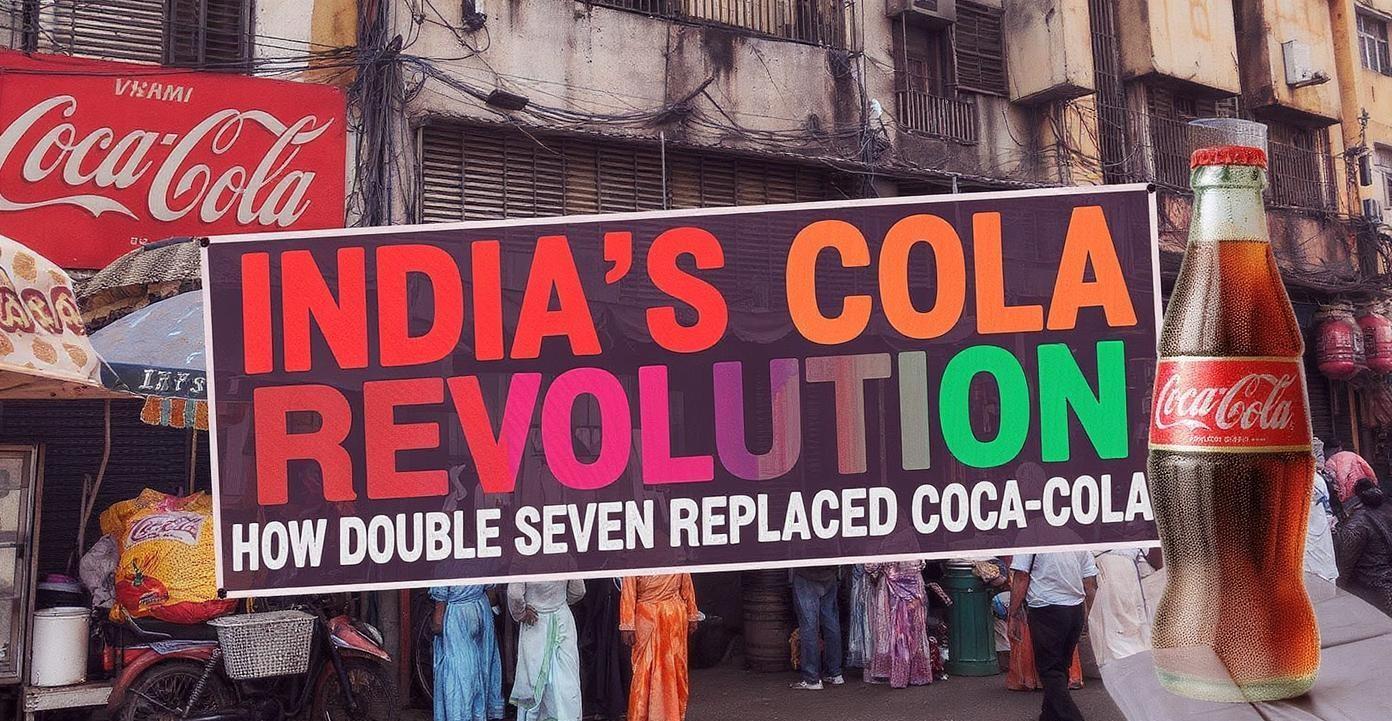
The narrative of India’s Cola Revolution: How Double Seven Replaced Coca-Cola is one of corporate disruption, national identity, and economic assertion. It captures the moment when India, newly awakened from the turbulence of the Emergency, took bold steps toward asserting its sovereignty—not just in governance, but in commerce. Coca-Cola, a symbol of Western consumerism, was ousted from India in 1977. In its place rose Double Seven, a government-backed soft drink brand that embodied Indian aspirations and self-reliance.
This revolution wasn’t merely about a beverage—it was about an idea. It questioned the dominance of foreign brands and celebrated the power of indigenous enterprise. The swadeshi movement found a new icon in Double Seven, and thus began India’s Cola Revolution: How Double Seven Replaced Coca-Cola, a compelling chapter in India's consumer and political history.
Coca-Cola’s Exit: A Policy-Driven Market Shift
In the 1970s, India was undergoing significant political and economic restructuring. The Janata Party came to power in 1977 with a mission to cleanse the economy of foreign monopolies and to build a self-sustaining industrial system. The government imposed stringent regulations under the Foreign Exchange Regulation Act (FERA), requiring foreign companies to dilute equity and share proprietary information.
Coca-Cola refused to reveal its closely guarded formula or reduce its equity stake. As a result, it chose to exit India, leaving a gaping void in the country’s soft drink market. But this void didn’t last long. The government responded swiftly with the launch of a locally produced cola—Double Seven. This marked the beginning of India’s Cola Revolution: How Double Seven Replaced Coca-Cola, where a state-sponsored initiative aimed to challenge a global titan on home turf.
Double Seven: A Political and Cultural Statement
Double Seven wasn’t just a product; it was a political symbol. Named after the year of the Janata Party’s historic victory (1977), the cola represented a new era of governance and consumer consciousness. It was produced and distributed by the Indian Tourism Development Corporation (ITDC), ensuring wide reach across government-run canteens, public institutions, and national events.
This beverage carried more than sugar and fizz—it carried the aspirations of a nation determined to prove its industrial and entrepreneurial mettle. India’s Cola Revolution: How Double Seven Replaced Coca-Cola symbolized an era of transformation, where India attempted to build a new economic identity by minimizing dependency on foreign players.
Marketing with Nationalism
Unlike the aggressive marketing strategies employed by private firms like Thums Up and Campa Cola, Double Seven relied heavily on its political symbolism. Its core message wasn’t about taste or refreshment—it was about patriotism. It appealed to citizens’ desire to support Indian products during a time of national renewal.
Government offices, railways, and state events were instrumental in promoting the brand. Double Seven became the default cola at these venues. This strategy ensured widespread visibility without the need for massive advertising budgets. The emotional appeal was so strong that for many, drinking Double Seven was a declaration of support for Indian enterprise. This marked the high point of India’s Cola Revolution: How Double Seven Replaced Coca-Cola, where patriotism sold more than advertising ever could.
Emerging Rivals: Thums Up and Campa Cola
Although Double Seven had state support, it wasn’t the only contender vying to replace Coca-Cola. Parle launched Thums Up, while Pure Drinks introduced Campa Cola. These brands adopted more traditional marketing strategies and emphasized product taste and style. Thums Up, with its bold flavor and youth-oriented campaigns, quickly gained market share.
Double Seven, however, maintained strong government presence and loyalty among institutional consumers. Its pricing and availability gave it an edge in semi-urban and rural markets. For a time, all three brands coexisted, creating a unique period in Indian FMCG history where indigenous brands dominated the cola segment. But it was India’s Cola Revolution: How Double Seven Replaced Coca-Cola that represented a deeper narrative of national change.
Distribution and Government Muscle
One of Double Seven’s core strengths was its access to government-backed distribution. The product was stocked at railway canteens, army supply depots, and tourism centers. This widespread availability made Double Seven a household name, particularly in areas where private companies had limited reach.
The ITDC's infrastructure ensured the beverage could penetrate remote areas and serve consumers who had limited access to premium soft drink options. While Thums Up ruled urban hearts, Double Seven quenched the thirst of India’s hinterlands. This dual-market dynamic allowed the brand to stay competitive for several years, reinforcing the influence of India’s Cola Revolution: How Double Seven Replaced Coca-Cola in shaping a truly nationwide movement.
Challenges in the Liberalization Era
By the early 1990s, India had embarked on a new journey—economic liberalization. With the dismantling of trade barriers and deregulation of industries, the Indian market reopened to foreign players. Coca-Cola returned in 1993 and acquired Thums Up, its former local rival. With deep pockets and global brand power, Coca-Cola quickly reclaimed lost ground.
Double Seven, still under state control, struggled to keep pace. It lacked the funds, marketing acumen, and product innovation required to compete in a liberalized economy. As private players modernized their packaging, diversified their offerings, and roped in celebrity endorsements, Double Seven remained trapped in an outdated bureaucratic framework. Slowly, it faded from store shelves and public memory. The decline marked the end of an era, but the legacy of India’s Cola Revolution: How Double Seven Replaced Coca-Cola continues to inspire conversations around national identity and market dynamics.
Branding Lessons from Double Seven
Even though Double Seven eventually exited the market, its story offers timeless branding lessons:
Leverage Socio-Political Sentiment: Products aligned with national mood can spark immediate emotional connection.
Strategic Distribution Matters: Government networks gave Double Seven unmatched reach during its peak.
Consistency Over Glamour: Emotional branding can sometimes outperform flashy advertisements.
Adaptation Is Key: Failure to evolve with consumer trends and economic shifts can neutralize even the most meaningful brand story.
Modern marketers can draw immense value from the brand journey of Double Seven. India’s Cola Revolution: How Double Seven Replaced Coca-Cola exemplifies how context, timing, and sentiment can shape an entire category.
The Cultural Legacy of Double Seven
Double Seven may have disappeared from the market, but its cultural impact lingers. It was a brand that embodied a moment in time—a brief but bold attempt to challenge the status quo and create something uniquely Indian. It wasn’t just a drink; it was a message.
The spirit of Double Seven lives on in today’s Make in India campaigns and the rise of homegrown brands in various sectors—from technology to textiles. The success of these initiatives traces its ideological roots back to India’s Cola Revolution: How Double Seven Replaced Coca-Cola, which proved that Indian consumers are willing to embrace domestic innovation when it aligns with national sentiment.
Relevance in Today’s Market Environment
In today’s globalized world, the appetite for local brands is resurging. Consumers are becoming more conscious of origin, sustainability, and economic impact. Startups like Paper Boat, Bira, and Patanjali have successfully blended swadeshi values with modern marketing—something Double Seven attempted long before it was trendy.
Today’s business leaders can revisit India’s Cola Revolution: How Double Seven Replaced Coca-Cola to understand how brands can be built not just with money, but with mission. The campaign around Double Seven was imperfect, but visionary. It serves as a guidepost for creating brands that reflect national pride, cultural nuance, and market responsiveness.
Read Full Article : https://bizinfopro.com/news/marketing-news/indias-cola-revolution-how-double-seven-replaced-coca-cola/
About Us : BizInfoPro is a modern business publication designed to inform, inspire, and empower decision-makers, entrepreneurs, and forward-thinking professionals. With a focus on practical insights and in‑depth analysis, it explores the evolving landscape of global business—covering emerging markets, industry innovations, strategic growth opportunities, and actionable content that supports smarter decision‑making.

 Arabic
 French
 Spanish
 Portuguese
 Deutsch
 Turkish
 Dutch
Dutch
 Italiano
 Russian
 Romaian
 Portuguese (Brazil)
 Greek
Greek